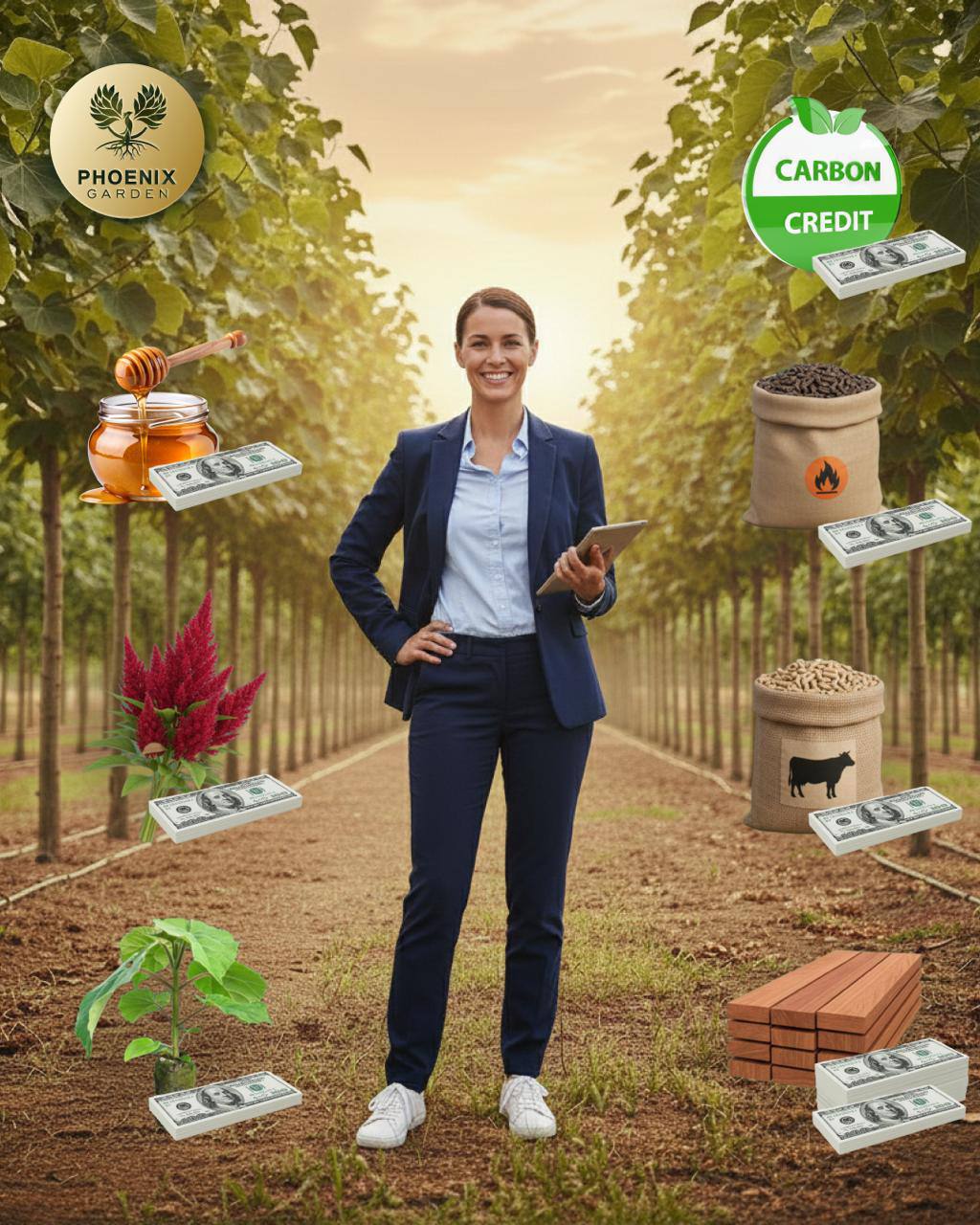
After more than a year of active development, we have identified 7 key areas of profit generation that became the foundation of our project. In the process, we brought together experienced specialists in paulownia plantations, agroforestry, and related fields. Through joint efforts, our team has created a diversified income model ensuring stable profitability.
Now, let’s take a closer look at each product.
🌱Amaranth
Amaranth is grown as a secondary intercrop between tree rows, providing a quick harvest twice a year. Profit starts from the first year through product sales to the food industry, animal feed, and export. High profitability is achieved thanks to low planting costs.
Annual profit: ~$210,600.
🌿Seedlings
Tree seedlings are produced in our own nurseries using non-standard material and sold to farmers, landscaping companies, and private buyers. This direction provides early income within 1–2 years after plantation launch and has strong potential for scaling into a full-fledged business.
Annual profit: ~$6,240.
🍯 Honey
Paulownia flowering creates ideal conditions for beekeeping, yielding abundant honey from the installed hives. The products are sold wholesale and retail, ensuring stable annual income starting from the 3rd–4th year after planting.
Annual profit: ~$240,000.
🌍Carbon Credits
Paulownia absorbs CO₂ at an exceptional rate — up to 273 tons per 10 hectares per year — allowing the issuance of verified carbon credits on international platforms such as Verra. Monetization becomes possible from 100 hectares of plantations. With global demand for carbon neutrality rising, the value of credits increases, providing passive income throughout the project’s life cycle.
Annual profit: ~$76,000.
🐄 Biomass
Paulownia biomass serves as a valuable feed resource for livestock. Its leaves and green mass contain about 20% protein, comparable to alfalfa, making it suitable for cows, sheep, goats, and other herbivores.
Annual profit: ~$465,000.
🔥Pellets
Wood waste is processed into fuel pellets with low ash content and higher combustion temperature compared to other wood species. This eco-friendly fuel suits boilers and stoves, offering both efficiency and environmental benefits. The growing demand for “green” energy expands market opportunities, and ENplus certification opens access to export markets and long-term contracts.
Profit per cycle: ~$2,441,250.
🪵Timber
After 7–8 years, paulownia produces high-quality, lightweight, and durable timber for furniture, plywood, and lumber industries. Trees regenerate naturally without replanting, providing multiple harvest cycles. The wood’s excellent strength-to-weight ratio makes it highly valued for export in the furniture and sports industries.
Profit per cycle: ~$19,250,000.
💎Profit for Investors
Phoenix Garden investors receive regular profit shares proportional to their holdings, starting from the first monetized streams and peaking every 8 years. The transparent distribution system ensures a stable passive income for over 40 years.
Invest today — and secure financial independence for generations ahead!
Now, let’s take a closer look at each product.
🌱Amaranth
Amaranth is grown as a secondary intercrop between tree rows, providing a quick harvest twice a year. Profit starts from the first year through product sales to the food industry, animal feed, and export. High profitability is achieved thanks to low planting costs.
Annual profit: ~$210,600.
🌿Seedlings
Tree seedlings are produced in our own nurseries using non-standard material and sold to farmers, landscaping companies, and private buyers. This direction provides early income within 1–2 years after plantation launch and has strong potential for scaling into a full-fledged business.
Annual profit: ~$6,240.
🍯 Honey
Paulownia flowering creates ideal conditions for beekeeping, yielding abundant honey from the installed hives. The products are sold wholesale and retail, ensuring stable annual income starting from the 3rd–4th year after planting.
Annual profit: ~$240,000.
🌍Carbon Credits
Paulownia absorbs CO₂ at an exceptional rate — up to 273 tons per 10 hectares per year — allowing the issuance of verified carbon credits on international platforms such as Verra. Monetization becomes possible from 100 hectares of plantations. With global demand for carbon neutrality rising, the value of credits increases, providing passive income throughout the project’s life cycle.
Annual profit: ~$76,000.
🐄 Biomass
Paulownia biomass serves as a valuable feed resource for livestock. Its leaves and green mass contain about 20% protein, comparable to alfalfa, making it suitable for cows, sheep, goats, and other herbivores.
Annual profit: ~$465,000.
🔥Pellets
Wood waste is processed into fuel pellets with low ash content and higher combustion temperature compared to other wood species. This eco-friendly fuel suits boilers and stoves, offering both efficiency and environmental benefits. The growing demand for “green” energy expands market opportunities, and ENplus certification opens access to export markets and long-term contracts.
Profit per cycle: ~$2,441,250.
🪵Timber
After 7–8 years, paulownia produces high-quality, lightweight, and durable timber for furniture, plywood, and lumber industries. Trees regenerate naturally without replanting, providing multiple harvest cycles. The wood’s excellent strength-to-weight ratio makes it highly valued for export in the furniture and sports industries.
Profit per cycle: ~$19,250,000.
💎Profit for Investors
Phoenix Garden investors receive regular profit shares proportional to their holdings, starting from the first monetized streams and peaking every 8 years. The transparent distribution system ensures a stable passive income for over 40 years.
Invest today — and secure financial independence for generations ahead!